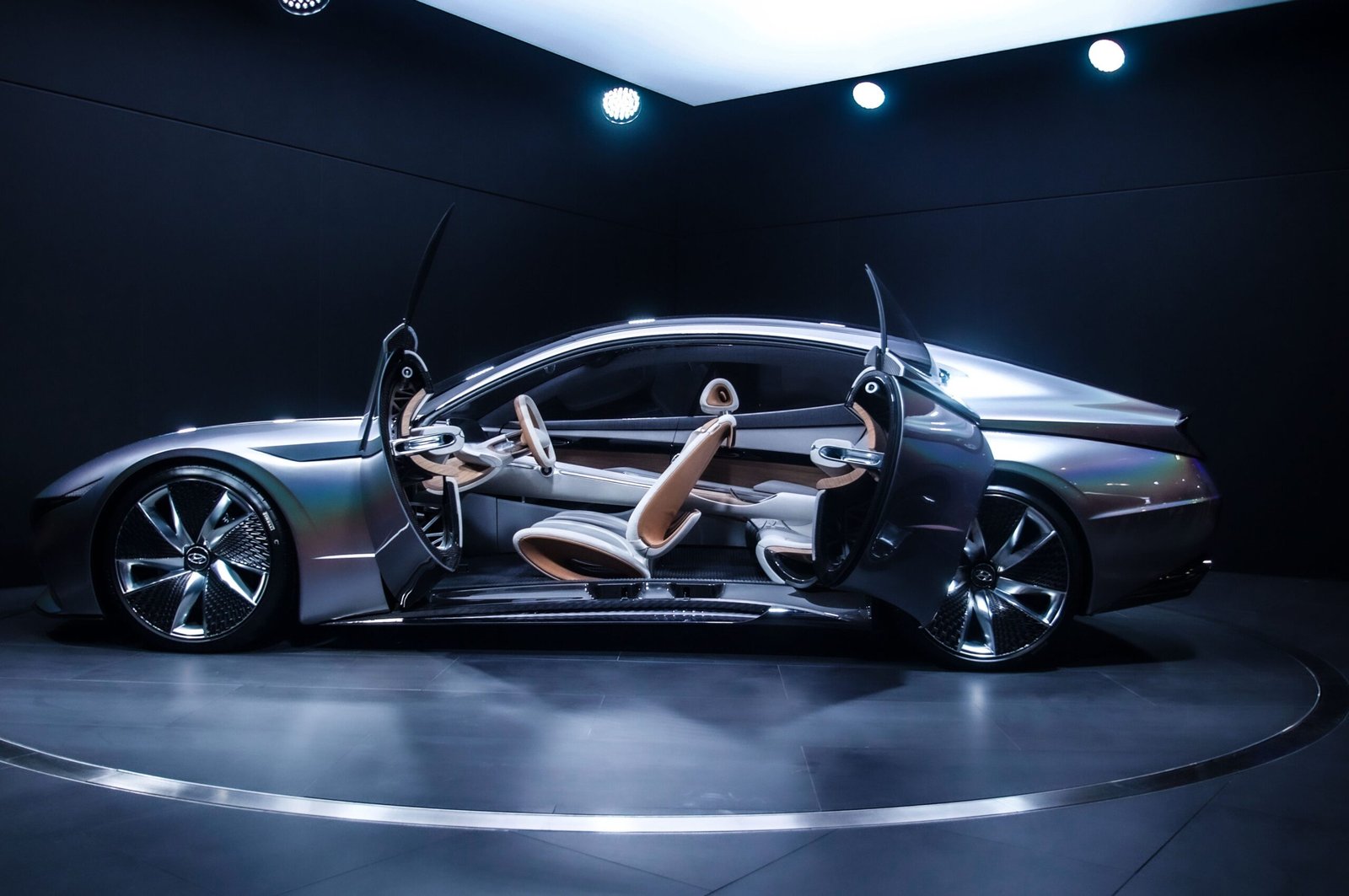

One of the most important applications of artificial intelligence in modern vehicles is Advanced Driver Assistance Systems (ADAS).
AI-powered systems use cameras, radar, sensors, and computer vision to monitor the vehicle’s surroundings and identify potential hazards.
Some common features include:
- Automatic emergency braking.
- Lane departure warnings.
- Adaptive cruise control.
- Blind-spot monitoring.
- Pedestrian detection.
- Traffic sign recognition.
- Intelligent parking assistance.
For example, if a vehicle detects a potential collision, its emergency braking system may automatically apply the brakes when the driver does not respond in time.
These technologies help drivers make safer decisions and reduce the risk of certain accidents.
However, ADAS systems are driver-assistance tools, not replacements for responsible driving.
IEA
+1
2. Autonomous and Self-Driving Cars

Artificial intelligence is a major technology behind autonomous driving.
Self-driving systems use AI algorithms to interpret information collected through cameras, radar, LiDAR, and other sensors.
The technology allows vehicles to:
- Recognize pedestrians and other vehicles.
- Identify traffic signs and road markings.
- Detect obstacles.
- Estimate the movement of surrounding traffic.
- Plan driving routes.
- Make certain driving decisions.
Autonomous driving technology is classified into six levels, ranging from Level 0 to Level 5.
In 2026, Level 2 driver-assistance systems are increasingly common, while Level 4 driverless services operate commercially in selected cities.
However, fully autonomous Level 5 vehicles are not yet commercially available for general public use.
AI continues to improve how vehicles understand complex traffic situations, but unusual road conditions, unpredictable human behavior, and extreme weather remain significant challenges.
IEA
+1
3. Predictive Vehicle Maintenance

Traditional vehicle maintenance usually follows a fixed schedule based on mileage or time.
Artificial intelligence is introducing a smarter approach through predictive maintenance.
AI systems analyze information collected from vehicle sensors to identify patterns that may indicate developing mechanical problems.
They can monitor:
- Engine temperature.
- Battery performance.
- Oil pressure.
- Tire pressure.
- Brake-system information.
- Transmission behavior.
- Vehicle fault codes.
For example, an AI-powered system may identify unusual temperature patterns or changes in vehicle performance and alert the driver that an inspection is needed.
The main benefits include:
- Early identification of potential faults.
- Reduced unexpected breakdowns.
- Better maintenance planning.
- Lower vehicle downtime.
- Improved fleet reliability.
Predictive maintenance is particularly useful for commercial vehicles, delivery fleets, and transportation companies.
Intel
+1
4. AI-Powered Smart Infotainment Systems

Artificial intelligence is transforming the way drivers interact with their vehicles.
Modern infotainment systems increasingly include intelligent voice assistants that understand natural language and respond to driver commands.
Instead of navigating complicated menus, drivers can use voice commands to:
- Find nearby destinations.
- Control music.
- Adjust climate settings.
- Make phone calls.
- Receive traffic updates.
- Access vehicle information.
Some advanced systems can also learn individual preferences and personalize the driving experience.
For example, a vehicle may remember preferred seat settings, climate temperatures, and entertainment choices for different drivers.
Generative AI is also creating opportunities for more natural conversations between drivers and their vehicles.
These features should be designed to minimize distraction and keep drivers focused on the road.
Intel
+1
5. AI in Electric Vehicle Battery Management

Electric vehicles rely on sophisticated battery systems, and AI is helping manufacturers improve their performance.
AI-powered battery management can analyze temperature, voltage, charging patterns, and energy consumption to estimate battery condition more accurately.
Important applications include:
- Battery health monitoring.
- Charging optimization.
- Temperature management.
- Driving-range prediction.
- Battery degradation analysis.
- Energy consumption optimization.
For example, an intelligent battery system can use driving and environmental data to estimate how much energy remains and provide a more useful range prediction.
AI can also help coordinate charging schedules by considering electricity prices, grid demand, and renewable energy availability.
These developments may improve battery lifespan, charging efficiency, and the overall ownership experience of electric vehicles.
IEA
6. AI in Car Manufacturing and Production

Artificial intelligence is not limited to the vehicles themselves. It is also transforming how cars are manufactured.
Automotive factories use AI-powered robotics, computer vision, and data analytics to improve production efficiency and quality.
Important applications include:
- Automated assembly.
- Intelligent quality inspection.
- Production-line monitoring.
- Robotic welding.
- Manufacturing defect detection.
- Equipment maintenance.
For example, AI-powered cameras can inspect vehicle components and identify scratches, paint defects, or manufacturing inconsistencies.
AI systems can also monitor factory equipment and identify unusual operating patterns before machinery fails.
These technologies help manufacturers improve product consistency, reduce production waste, and minimize costly interruptions.
NIST
+1
7. AI in Car Design and Engineering

AI is changing how automotive engineers design and develop new vehicles.
Traditionally, designing a car involves extensive research, physical prototypes, engineering calculations, and repeated testing.
AI can accelerate parts of this process by analyzing large datasets and exploring different design possibilities.
Applications include:
- Aerodynamic optimization.
- Vehicle weight reduction.
- Engine and motor efficiency improvements.
- Crash simulation.
- Material selection.
- Virtual vehicle testing.
Generative design tools can help engineers explore different component shapes and structures based on specific performance requirements.
Digital twins are also becoming increasingly important. These are virtual representations of physical vehicles or manufacturing systems that can be used to simulate performance and test improvements.
As a result, AI can help manufacturers reduce development time and improve engineering decisions.
Intel
+1
8. AI-Powered Driver Monitoring and Safety

Driver fatigue and distraction are important road-safety concerns.
AI-powered driver-monitoring systems use cameras and computer vision to observe driver behavior.
These systems can identify signs of:
- Drowsiness.
- Eye closure.
- Distraction.
- Head movement.
- Reduced attention.
If the system detects possible fatigue, it can issue an audible or visual warning.
Some vehicles also include occupant-monitoring technology to help identify passengers, recognize seat occupancy, and improve safety-system operation.
These features can be particularly useful during long journeys and highway driving.
However, their effectiveness depends on proper sensor operation, system design, and real-world driving conditions.
9. AI in Traffic Management and Navigation

Artificial intelligence is also influencing transportation beyond individual vehicles.
Smart traffic-management systems use AI to analyze traffic flow, identify congestion, and improve road-network efficiency.
These systems can process information from:
- Road cameras.
- GPS devices.
- Connected vehicles.
- Traffic sensors.
- Navigation applications.
- Smart traffic signals.
AI can use this information to suggest alternative routes and help authorities manage traffic more effectively.
For example, intelligent traffic signals can adjust their timing based on the number of vehicles approaching an intersection.
In large cities, these technologies could help reduce unnecessary waiting, improve traffic movement, and support emergency vehicle routing.
10. AI in Automotive Sales and Customer Service

Artificial intelligence is changing how automotive businesses communicate with customers.
Car manufacturers, dealerships, and service centers are using AI-powered tools to improve customer experiences and business operations.
Common applications include:
- AI-powered customer support.
- Personalized vehicle recommendations.
- Digital showroom experiences.
- Inventory management.
- Sales forecasting.
- Automated appointment scheduling.
- Customer preference analysis.
For example, an AI-powered dealership assistant can help customers compare different models, understand specifications, and arrange service appointments.
AI can also analyze purchasing patterns to help manufacturers understand which features customers prefer.
These tools allow automotive businesses to provide faster and more personalized services.
Intel
+1
How AI Is Transforming Different Areas of the Automotive Industry
| Automotive Area | AI Application | Main Benefit |
|---|---|---|
| Driving safety | ADAS | Accident prevention assistance |
| Autonomous vehicles | Computer vision | Automated driving |
| Maintenance | Predictive analytics | Early fault detection |
| Infotainment | AI assistants | Better convenience |
| Electric vehicles | Battery optimization | Improved efficiency |
| Manufacturing | Intelligent robotics | Higher productivity |
| Engineering | Generative design | Faster development |
| Driver safety | Driver monitoring | Fatigue detection |
| Traffic management | Smart traffic systems | Reduced congestion |
| Dealerships | AI customer support | Better customer service |
Challenges of Artificial Intelligence in the Automotive Industry
Although AI offers many benefits, its adoption also introduces important challenges.
1. Cybersecurity Risks
Connected vehicles collect and exchange significant amounts of information. Manufacturers must protect vehicle software, communication systems, and customer data against cyber threats.
2. High Development Costs
Developing AI systems requires advanced processors, sensors, software engineers, testing facilities, and significant investment.
3. Data Privacy
AI-powered vehicles may collect information about driving habits, location, and personal preferences. Companies must manage this information responsibly.
4. Safety and Reliability
AI systems can make mistakes, particularly when encountering unusual situations or conditions that were not adequately represented in their training data.
5. Regulatory Challenges
Different countries have different rules regarding autonomous driving, vehicle safety, data protection, and AI technology.
These challenges mean that responsible development, proper testing, and human oversight remain essential.
The Future of Artificial Intelligence in the Automotive Industry
Artificial intelligence is expected to become even more important in the automotive industry over the coming years.
Some developments worth watching include:
- More advanced autonomous driving systems.
- Smarter electric vehicle battery management.
- AI-powered digital assistants.
- Fully connected software-defined vehicles.
- Intelligent manufacturing facilities.
- More accurate predictive maintenance.
- Improved vehicle cybersecurity.
- Personalized driving experiences.
The International Energy Agency’s 2026 research highlights AI’s growing importance in automated driving, battery management, and electric vehicle charging coordination.
IEA
+1
For automotive manufacturers, AI will increasingly become a competitive advantage rather than simply an optional technology.
What Does AI Mean for Car Buyers in Pakistan?
AI-powered technology is gradually becoming more relevant to Pakistani car buyers as manufacturers introduce vehicles with advanced safety, connectivity, and driver-assistance features.
Before purchasing a technologically advanced vehicle, consider:
- Availability of local software and service support.
- Reliability of electronic components.
- Availability of genuine spare parts.
- ADAS performance on local roads.
- Availability of software updates.
- Warranty coverage for electronic systems.
- Cost of repairs and replacement components.
In cities such as Islamabad, Lahore, Karachi, and Peshawar, connected technology and driver-assistance features may offer useful benefits.
However, buyers should remember that advanced driving assistance systems may not perform equally well on every road, especially where lane markings, road signs, and traffic conditions are inconsistent.
Choose a vehicle based on practical safety, reliability, and ownership costs rather than technology features alone.
Conclusion
Artificial intelligence is transforming the automotive industry in ways that go far beyond self-driving cars.
From intelligent safety systems and predictive maintenance to smart manufacturing, battery optimization, and personalized infotainment, AI is influencing almost every stage of a vehicle’s lifecycle.
These innovations are helping manufacturers develop smarter vehicles, improve production efficiency, and provide better customer experiences.
However, cybersecurity, data privacy, development costs, and safety concerns must be addressed before AI technology can reach its full potential.
Final verdict: Artificial intelligence is becoming one of the most important technologies shaping the future of transportation. Cars are evolving from traditional mechanical machines into intelligent, connected systems that can analyze information, assist drivers, and continuously improve through software.
For consumers, this means safer technology, smarter features, and potentially more efficient vehicles. For automotive manufacturers, AI will be a major factor in determining who leads the next generation of the automotive industry.